Happy 250th! Share your family’s Fourth of July traditions and earn a chance to win a video drone.
What You’ll Find

History of the Holiday
Each holiday page begins with a concise, engaging overview of how the holiday came to be, how Americans have celebrated it across time, and how its meaning has evolved for different communities.

Essential Readings
Recite the stirring words of Jefferson, Lincoln, King, Roosevelt, Maya Angelou, Langston Hughes, and many others. Each holiday includes curated texts that reflect the day’s history, controversy, and meaning.

Songs to Sing Together
Lyrics and simple chords for classic American songs—from “America the Beautiful” to “Lift Every Voice and Sing.” Bring music back into your celebrations.

Discussion and Trivia Questions for All Ages
Gently encourage families (and even disagreeing relatives) to talk about what the holiday means today. Civic conversation is part of the celebration.
Holiday-Specific Recipes
Make your holidays taste special with dishes used only on that day—turning food into ritual. From broccoli crunch salad to Thanksgiving pumpkin cream pie, each recipe helps mark the day as different.
Simple Ceremonies You Can Use Tonight
Short scripts help you open or close a holiday meal with intention. You can personalize or adapt them to your family’s traditions.
Introduction
This website began several years ago at a picnic table where my family gathered with close friends to celebrate the 4th of July. Our kids had just finished swimming (playing games like “Alligator tag” and “Goofy”), and we had fired up the barbeque with hot dogs, hamburgers, and sweet corn aplenty. The picnic table was piled with a cornucopia of dishes: pesto tortellini, potato salad, and the mid-western classic broccoli crunch salad, laden with Miracle Whip and bacon. Independence Day is our outdoor Thanksgiving. The younger kids impatiently waited for sundown—the chance to see our town’s fireworks, to “ooh” and “aah” in unison, and to waive some sparklers of their own.
But something was missing. We wanted to declare our day of independence together and mark the day with a fitting ritual that would center our collective attention on the reason for the celebrations. And so like generations of Americans before us, we gathered in a circle at the picnic table and began reading the unforgettable words, “When in the Course of human events . . . “—each person reading a sentence and then passing a copy of the Declaration of Independence around, from parent to child and back again, with adults helping younger readers with the pronunciation of “unalienable” and a few other words.
Listen to the varied styles of orations as the copy passes from hand to hand. Some are timid; some warm to the task of denouncing the outrages and perfidy of King George. Hear the awkward embarrassment when one speaker describes Native Americans as “merciless Indian Savages, whose known rule of warfare is an undistinguished destruction of all ages, sexes and conditions.” Embrace the rousing declaration that the colonies “are, and of Right ought to be Free and Independent States.” Thrill to that final, courageous promise of the fifty-six signers, “mutually pledg[ing] to each other our Lives, our Fortunes and our sacred Honor.”
In gathering to read the Declaration on the 4th of July, our family was continuing a tradition that, in some ways, began on July 8, 1776. On that day, the Liberty Bell sounded from the tower of Independence Hall, summoning citizens to gather for the first public reading of the Declaration of Independence by Colonel John Nixon. Since that time, Americans of all political persuasions have embraced and celebrated our founding document. Today, the Sons and Daughters of the American Revolution have public readings on July 4th at the graves of every signer. The National Archives has an annual public reading on the Mall in Washington, D.C. Dozens of legal bar associations organize local readings in cities throughout the country. For the last thirty-five years, National Public Radio has broadcast recordings of its hosts, reporters, newscasters and commentators taking turns reading portions of the text.

Colonel John Nixon reading Declaration from State House in Philadelphia
While it is a powerful experience to simply listen to the great speakers declaim the words—and on YouTube you can now easily reach back and listen to Presidents John Kennedy or Ronald Reagan recite—we think it is more in keeping with our great experiment in democracy to have the text read by “We, the People.” Smaller readings among family and friends allow everyone to take symbolic ownership of the day. For the last century, the New York Times has made it easy for its readers to do this by publishing the full text of the Declaration each and every Independence Day. Today, a copy of the Declaration can also be accessed from any Internet-enabled cellphone screen.
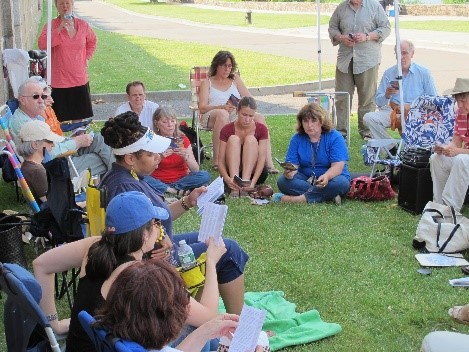

Americans continuing to read the Declaration today
This website is my attempt to help Americans celebrate the 4th of July and a variety of other American holidays. It provides a collection of canonical writings, speeches, songs, poems, and commentaries to help families reflect on the meaning of our holidays. Your family and friends will be able to recite the majestic words of Abraham Lincoln and Martin Luther King, of Thomas Jefferson and Franklin Delano Roosevelt. You can join in debating the meaning of the Constitution with Antonin Scalia and Joh Marshall. You can lift up your voice with the soaring poetry of Walt Whitman and Maya Angelou, and of Carl Sandburg and Langston Hughes.
We begin of course with Independence Day, but this website also provides briefer readings and songs that might be read or sung before other holidays, including Memorial Day or Labor Day. I’ve tried to have realistic ambitions. Few families want to spend an hour discussing the meaning of Veterans Day before sitting down to dinner on November 11. But thousands of our soldiers every day put their lives at risk to defend our country. There is a felt need by many Americans to do something to acknowledge their efforts.
In some ways, this website serves a reference. The introductory materials for each holiday’s “chapter” tell how the holiday came to be and something about its history. Those materials speak to what the day has meant to different people at different points in time. The website includes extensive annotation of the Declaration of Independence that breaks down the text’s structure and prose style. It provides background detail on each and every one of the document’s 28 grievances against George III as well as details on the earlier texts from which Thomas Jefferson heavily borrowed in drafting the Declaration. The Juneteenth materials include an extensive exegesis of both of Lincoln’s Emancipation Proclamations (some readers will be surprised to learn there were two). If you want to know why Thomas Jefferson took a razor blade to the Bible, or why FDR moved the date for Thanksgiving, you’ve come to the right place.
But this is also a “How To . . .” website. Readers who’ve had the chance to attend a seder during Passover will recognize a similarity between this website and the Haggadah, the guidebook (literally “order” or “sequence”) of readings and songs that Jewish families use to celebrate Passover dinner. This project is a patriotic Haggadah. It provides a step-by-step guide on what you might say or sing before tucking into a holiday dinner—and it often provides more than one option along the way. In keeping with the great American political project, you are invited to create your own holiday traditions, and I invite you to upload videos, photos, or text-based descriptions of your traditions.
This project is particularly tailored to families. Just as “republican mothers” at the time of the Revolution were tasked with inculcating civic virtue in their children, many parents today will want to use materials in this book to help raise their kids to be good citizens. The Passover seder is, in part, structured to fulfill the Exodus commandment (Ex. 13:8) that parents teach their children about an important moment in Jewish history. Analogously, reading and talking about these central words of our government is a great way for parents to tell their children about important moments in United States history—to pass on not just knowledge but also respect for the achievements of America.
The website unabashedly seeks to restore a small sense of ceremony for Independence Day and a few other American celebrations. Ceremonies help set particular moments apart in time. They signal that this day is different from all the rest. Whether it be a graduation or a church service, recitations of ceremonial words and songs mark events as symbolic of larger themes. They help channel moments of reflection and can reinforce social meanings about the nature of citizenship. Specific scripted language (which you should feel free to edit to taste) is provided to help initiate and end gatherings as an additional way give your holidays meaning and structure.
Food can also help set days apart. My family gathers around the hearth for cheese fondue and mock turtle soup before going to Christmas Eve midnight service. Part of what makes these meals special is that these are dishes that we only serve at Christmas (just as part of what has made Thanksgiving a tradition is that for many families it is the only day that we eat turkey with all the trimmings). The ritual of associating specific foods with specific holidays makes these days more meaningful. We feel left out if we don’t raise a glass of champagne with friends when the clock strikes midnight on New Year’s Eve or if we can’t sit down to dinner on Thanksgiving. We’ve included in this website some specific recipes that you might want to set aside for particular holidays. You’ll find “Audrey’s Pineapple Cake” recipe with this website’s Thanksgiving materials, but you might prefer to incorporate it as part of your Independence Day or Labor Day celebration. Most importantly, we encourage you to start your own culinary traditions. You can make Memorial Day weekend more meaningful for your family by choosing to serve some tasty dish only on that day. After just a couple of years, your family will start associating that day with sitting down to eat that treat.
Something as arbitrary as the ceremonial aspect of a holiday food can undergird other moments of reflection—especially if combined with some of the words and songs included in this book.
We have some sense of what it means to “practice” a religion. But what does it mean to be a “practicing American”? As with most religions, it requires something more than simply mouthing the words of a sacred text. To that end, this website hopes to create a space for your family to reflect on the meaning of these holidays. Rote recitation of even the loftiest phrases of our nation’s founders can with repetition tend to drain the words of their meaning. So this website also includes a series of discussion questions—some designated for all ages, and others recommended just for adults. After reading the Declaration or “I Have a Dream,” your family and friends might decide to practice your citizenship by talking about what it means to you.
While we often try to avoid political arguments at holidays, this project encourages you to lean into the discomfort and have the conversation anyway. It is designed to create opportunities for family and friends to civilly engage with each other on what it means to be American. Our country finds itself at a time of great political division, when even trust in basic institutions of democracy has eroded. This website aims to play a small role in helping people with different beliefs reaffirm their appreciation for the foundations and institutions they share. Perhaps the materials assembled here will help your family and friends find common ground centered on substantive values: the importance of transparency and truth in government; the value of voting; or what it means to sacrifice for our country. But it may be your discussions will not yield such commonly shared values; indeed, by talking about national holidays, you might discover—and clarify—the basis for your disagreements with people who matter to you. If so, this website might serve to reassure you that this disagreement is something not to be cursed or denied, but to be celebrated as a core element of practicing American citizenship.
A close look at our national holidays will help reveal that contestation has always existed at the core of American identity. We can dissent from common opinions and disagree or debate with each other while still sharing in something bigger than ourselves. Deep controversies about meaning even attend our days of celebration. Indeed, if this project has a thesis, it is that every holiday has, over our county’s history, meant strikingly different things to different people. Should Labor Day celebrate or bemoan the right of collective bargaining and the trade union movements? What should Veterans Day mean to people who think we should “study war no more”? How, if at all, should we respond to the truth that some of our greatest presidents owned slaves or that Martin Luther King, Jr. was imperfect? Even a holiday as seemingly non-controversial as Thanksgiving gives rise to questions about our nation’s treatment of indigenous people and whether the holiday is giving thanks to God.
The very holidays that celebrate our identity, experiences, and achievements as Americans have given rise to just the sort of disagreement and dissent our American identity fosters. It should be profoundly reassuring to us as Americans to look back and see that we are a people who deeply engage the meaning of our life together, and still come together, in the Declaration’s audacious claim, as “one people.” We have always done so, and we can, with deliberation, continue this tradition. If we can come together to throw off England’s tyrannical rule and, later, the enslavement of millions of Americans, we can come together notwithstanding our serious political and ethical disagreements.
The goal of this website is not, then, to subscribe to a single set of values or substantive ideas, but to commit ourselves, collectively, to a process for discussing those ideas—one that is civil, curious, mutually respectful, and open to listening and learning. And American holidays are a perfect time for such conversations. This website presents multiple perspectives in the hopes of fostering a mature love for our country. Pausing before we eat—speaking some of the words on this website with our loved ones and reflecting about their meaning—has enriched our lives. I fervently hope that this work will also deepen your families’ connections to each other and to our great country.
Note about the Music: The songs included in this website come with lyrics and simplified guitar chords. You can learn the melodies to any of these songs by searching for the title on YouTube. I am also a humongous fan of Rise Up Singing, which has provided my family with hours of pleasure and can provide you with additional songs to sing.