
Labor Day
Source: Frank Leslie's Illustrated Newspaper, 1882 — First Labor Day Parade, New York City, via Wikimedia Commons
History
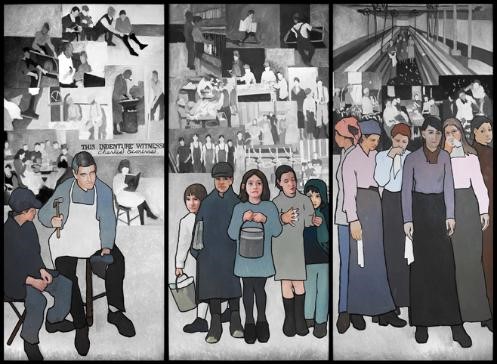 Judy Taylor, Maine Department of Labor Mural (Panels 1-3) (2008)
At its inception, Labor Day was one of our most controversial holidays. Most other countries celebrate May 1st as Labor/International Workers’ Day. But even though that particular day for celebrating labor has an American origin, our country’s choice to celebrate in September is the result of a historical political compromise. On May 1, 1886, Samuel Gompers, the founder of the American Federation of Labor, organized a general strike of workers throughout the United States to demand an eight-hour workday. Four days later, as the strike escalated in Chicago, a terrible riot erupted at Haymarket Square where a policeman was killed after someone threw a bomb. The events surrounding the strike, the riot, and the controversial conviction and ultimate hanging of four labor leaders became a powerful symbol of the struggle between labor and management which polarized supporters and critics of the trade union movement. Many Americans were repulsed by the violence and perceived the strike leaders to be foreign-born anarchists. For many labor supporters, however, the executed leaders were martyrs, and the May 1st strike represented a new dawn for workers’ solidarity.
In 1889, Gompers wrote to the Second International in Paris[1] calling for an international strike on May 1st to support a universal eight-hour workday. Friedrich Engels, the co-author of the Communist Manifesto, eagerly embraced the idea. On May 1, 1890, thousands of workers took to the streets in dozens of countries in Europe and the Americas. Commemorating May Day as a workers’ day of action became an annual international event.
But things changed in 1894 after Eugene Deb’s American Railway Union supported a strike by Pullman Palace Car workers which paralyzed much of America’s railroad traffic. As described by Forbes journalist Mark Lewis:
President Grover Cleveland, a conservative Democrat, was determined to squash the strike. But he did not want to alienate the American Federation of Labor, which was not yet involved in the Pullman dispute. Moreover, 1894 was a midterm election year, and the Democratic Party could ill afford to be seen as an enemy of labor. Cleveland and the Democrats hit upon a possible solution: They would proclaim a national Labor Day to honor the worker. But not on May 1—that date was tainted by its association with socialists and anarchists. Fortunately, an alternative was at hand.
Back in September 1882, certain unions had begun to celebrate a Labor Day in New York City. By 1894, this event was an annual late-summer tradition in New York and had been adopted by numerous states, but it was not a national holiday. Nor was it associated with the radicals who ran the Second International, and who liked to run riot on May Day.
On the contrary, the September date was closely associated with Gompers, who was campaigning to have it declared a national holiday. Gompers opposed the socialists and was guiding the AFL toward a narrower and less-radical agenda. Gratefully, Cleveland seized upon the relatively innocuous September holiday as a way to reward labor without endorsing radicalism. On June 28, 1894, he signed an act of Congress establishing Labor Day as a federal holiday on the first Monday of September. (He made a point of sending the signing pen to Gompers as a souvenir.) Less than a week later, the president sent federal troops to Chicago. Gompers refused to support the strike, which soon collapsed.
Gompers was related perversely to both the rise and fall of May 1st as America’s day to honor workers.
Labor rights (including the rights of workers to collectively unionize) continue to be politically controversial today. The paintings reproduced above are three panels of a mural celebrating labor that hung in the Maine Department of Labor building until they were ordered removed by Governor Paul LePage in 2011. The acting commissioner for the Department explained at the time that because of the mural, “the administration building is not perceived as equally receptive to both businesses and workers.”[2]
In keeping with this fraught history, we have included readings and songs from different perspectives. For those who want to honor the dignity of labor, we recommend De Tocqueville’s essay and Bernstein’s offering from Candide. For those who are more interested in a full-throated support of workers’ rights, we recommend Gompers’s or FDR’s writings. You might even have your family members try their hand at the unapologetic “Hallelujah I’m a Bum” or the downright subversive “Internationale,” which was adopted as the official anthem of the Second International.
Guide for Celebration
Every meaningful gathering benefits from gentle guidance—someone to call the group together, set the tone, and help navigate the journey from ordinary time into a space of reflection and back again. This role of celebration Leader is not about authority or expertise, but about service: creating a container within which your family and friends can encounter these powerful texts and ideas together. Think of yourself less as a teacher and more as a facilitator, helping to orchestrate an experience that allows everyone present to engage with America’s founding documents and ongoing story.
The concept of liturgical leadership has deep roots across human cultures. From the ancient symposium to the Passover seder, from Quaker meetings to town halls, communities have long recognized that structured gatherings with designated facilitators help create “liminal space”—a threshold moment set apart from everyday life where transformation and deeper understanding become possible. By taking on this role, you’re not imposing artificial formality but rather tapping into a fundamental human practice: marking significant moments through deliberate, communal action.
If this feels awkward or pretentious at first, you’re not alone. Many Americans are unaccustomed to bringing ceremonial structure to secular holidays beyond saying grace at Thanksgiving. You might worry about seeming preachy or overly formal, especially with teenagers rolling their eyes or relatives who “just want to eat already.”
But consider this: we readily accept structure in other contexts—wedding toasts, birthday songs, even the seventh-inning stretch. What we’re proposing here is simply extending that same intentionality to holidays that celebrate our shared civic life. Start small if needed—perhaps just reading a single paragraph of the Declaration before your Fourth of July barbecue—and build from there. The simple act of pausing together, even briefly, to acknowledge why we’ve gathered can transform a meal into a memory and a holiday into a tradition.
The Leader will gather the people together, saying:
Dear Friends, [Please stand.] We are gathered here to celebrate Labor Day by reading
[An excerpt from Alexis De Tocqueville’s great work, Democracy in America, in which the political theorist and historian reflects upon the nature of labor and work ethic in the early Republic.]
[or the poem, “Chicago,” which was composed by Carl Sandburg as a celebration of the great laboring city and the dignity of industry.]
[or an excerpt from Labor and the Common Welfare, a book by the union organizer Samuel Gompers, which discusses the rights of workers to a good wage and fair working conditions and the necessity of labor unions to achieve those ends.]
[or an excerpt from FDR’s Second Bill of Rights, which was introduced in 1944 to guarantee labor rights to all workers]
[or a song celebrating work, the working class, and solidarity among working people].
Please turn to [page xxx of your reader/on the printout on the table/by Googling xxx]. Let us go clockwise around [the table, the circle] staring with [xxx/the youngest/the guest], taking turns each person reading one sentence.
After the reading, the Leader may ask the group one or more of the following questions:
The Leader may conclude the celebration by saying:
Thank you for joining together to celebrate Labor Day. Let’s continue to reflect on the words we’ve heard, take them into our hearts and minds, and use them to become better friends, better coworkers and students, and better citizens and members of our nation.
Discussion Questions
Discussion Questions for Labor Day:
For everyone (young children included):
- Talk about your own family’s labor history. What occupation did your grandparents have? Your great-grandparents?
- What is a “union”? What are some of the things unions do?
- How do you think workers and their boss should treat each other?
- Would you prefer to celebrate Labor Day on May 1? Why or why not?
For older children and adults:
- What are the upsides of unionization? What are the downsides?
- What does “solidarity” mean to you? Do you think the concept is applicable to all modern workplaces?
- Are there any labor actions (like strikes and boycotts) that you think are out of bounds and shouldn’t be used? What about for management?
- Does celebrating American workers also mean embracing policies that encourage job creation through free markets rather than government intervention?
- Should everyone have a union? Are there categories of workers that should not have a union?
- Should unions be exempt from our antitrust laws?
- Production for many manufactured goods has moved overseas. Do you think that this development should lead to a reconsideration of U.S. labor relations? How?
- How do small business owners fit into the labor conversation, since they’re often both workers and employers?
- Should public-sector unions be treated differently from private-sector unions because they bargain against taxpayers?
- In an era of declining union membership, should alternative worker-representation models be considered?
Readings
Why Among The Americans All Honest Callings Are Considered Honorable
Alexis De Tocqueville, Democracy in America,
Volume 2, Section 2, Chapter 18 (1840)
Among a democratic people, where there is no hereditary wealth, every man works to earn a living, or has worked, or is born of parents who have worked. The notion of labor is therefore presented to the mind, on every side, as the necessary, natural, and honest condition of human existence. Not only is labor not dishonorable among such a people, but it is held in honor; the prejudice is not against it, but in its favor. In the United States a wealthy man thinks that he owes it to public opinion to devote his leisure to some kind of industrial or commercial pursuit or to public business. He would think himself in bad repute if he employed his life solely in living. It is for the purpose of escaping this obligation to work that so many rich Americans come to Europe, where they find some scattered remains of aristocratic society, among whom idleness is still held in honor.
Equality of conditions not only ennobles the notion of labor, but raises the notion of labor as a source of profit.
In aristocracies it is not exactly labor that is despised, but labor with a view to profit. Labor is honorable in itself when it is undertaken at the bidding of ambition or virtue. Yet in aristocratic society it constantly happens that he who works for honor is not insensible to the attractions of profit. But these two desires intermingle only in the depths of his soul; he carefully hides from every eye the point at which they join; he would gladly conceal it from himself. In aristocratic countries there are few public officers who do not affect to serve their country without interested motives. Their salary is an incident of which they think but little and of which they always affect not to think at all. Thus the notion of profit is kept distinct from that of labor; however they may be united in point of fact, they are not thought of together.
In democratic communities these two notions are, on the contrary, always palpably united. As the desire of well-being is universal, as fortunes are slender or fluctuating, as everyone wants either to increase his own resources or to provide fresh ones for his progeny, men clearly see that it is profit that, if not wholly, at least partially leads them to work. Even those who are principally actuated by the love of fame are necessarily made familiar with the thought that they are not exclusively actuated by that motive; and they discover that the desire of getting a living is mingled in their minds with the desire of making life illustrious.
As soon as, on the one hand, labor is held by the whole community to be an honorable necessity of man’s condition, and, on the other, as soon as labor is always ostensibly performed, wholly or in part, for the purpose of earning remuneration, the immense interval that separated different callings in aristocratic societies disappears. If all are not alike, all at least have one feature in common. No profession exists in which men do not work for money; and the remuneration that is common to them all gives them all an air of resemblance.
This serves to explain the opinions that the Americans entertain with respect to different callings. In America no one is degraded because he works, for everyone about him works also; nor is anyone humiliated by the notion of receiving pay, for the President of the United States also works for pay. He is paid for commanding, other men for obeying orders. In the United States professions are more or less laborious, more or less profitable; but they are never either high or low: every honest calling is honorable.
Samuel Gompers was an English-born cigar maker who founded the American Federation of Labor and served as its president, almost without interruption from 1886 until his death in 1924. Possibly his most soaring expression of aspiration of the labor movement came in a paper he read International Labor Congress in 1893:
What does labor want? We want more schoolhouses and less jails; more books and less arsenals; more learning and less vice; more leisure and less greed; more justice and less revenge; in fact, more of the opportunities to cultivate our better natures . . . .”
In this excerpt from Gompers’s book, Labor and the Common Welfare (1919), Gompers lays out a more formal vision of trade unions and their goals:
The trade unions are the legitimate outgrowth of modern society and industrial conditions. … They were born of the necessity of workers to protect and defend themselves from encroachment, injustice and wrong. … To protect the workers in their inalienable rights to a higher and better life; to protect them, no only as equals before the law, but also in their health, their homes, their firesides, their liberties as men, as workers, and as citizens; to overcome and conquer prejudices and antagonism; to secure to them the fight to life; the right to be full sharers in the abundance which is the result of their brain and brawn, and the civilization of which they are the founders and the mainstay; to this the workers are entitled. … The attainment of these is the glorious mission of the trade unions.
FDR’s “Second Bill of Rights”
Excerpt from President Franklin D. Roosevelt’s January 11, 1944 State of the Union message to the Congress of the United States:
It is our duty now to begin to lay the plans and determine the strategy for the winning of a lasting peace and the establishment of an American standard of living higher than ever before known. We cannot be content, no matter how high that general standard of living may be, if some fraction of our people—whether it be one-third or one-fifth or one-tenth—is ill-fed, ill-clothed, ill-housed, and insecure.
This Republic had its beginning, and grew to its present strength, under the protection of certain inalienable political rights—among them the right of free speech, free press, free worship, trial by jury, freedom from unreasonable searches and seizures. They were our rights to life and liberty.
As our nation has grown in size and stature, however—as our industrial economy expanded—these political rights proved inadequate to assure us equality in the pursuit of happiness.
We have come to a clear realization of the fact that true individual freedom cannot exist without economic security and independence. “Necessitous men are not free men.” People who are hungry and out of a job are the stuff of which dictatorships are made.
In our day these economic truths have become accepted as self-evident. We have accepted, so to speak, a second Bill of Rights under which a new basis of security and prosperity can be established for all—regardless of station, race, or creed.
Among these are:
The right to a useful and remunerative job in the industries or shops or farms or mines of the nation;
The right to earn enough to provide adequate food and clothing and recreation;
The right of every farmer to raise and sell his products at a return which will give him and his family a decent living;
The right of every businessman, large and small, to trade in an atmosphere of freedom from unfair competition and domination by monopolies at home or abroad;
The right of every family to a decent home;
The right to adequate medical care and the opportunity to achieve and enjoy good health;
The right to adequate protection from the economic fears of old age, sickness, accident, and unemployment;
The right to a good education.
All of these rights spell security. And after this war is won we must be prepared to move forward, in the implementation of these rights, to new goals of human happiness and well-being.
America’s own rightful place in the world depends in large part upon how fully these and similar rights have been carried into practice for all our citizens.
For unless there is security here at home there cannot be lasting peace in the world.
Poems and Songs
Hallelujah I’m a Bum
Words: Harry McClintock; Music: John J. Husband
Here is a great Wobbly folk song sung to the gospel tune “Revive Us Again.”, The second verse presents one of the more succinct implications of Marx’s labor theory of value!
Chords
G - - - / - - - D / G - - D / G C D C /
How the hell can I work when there’s no work to do?
Hallelujah! I'm a bum, Hallelujah bum again,
Hallelujah! give us a handout and revive us again.
The boss will be broke & to work he must turn. Hallelujah . . .
How can I get a job when you're holding down two? Hallelujah . . .
That’s why I am starving out on the bread line. Hallelujah . . .
Well if I didn't eat, I'd have money to burn. Hallelujah . . .
The lady said, "Scram, bum, you've been here before!" Hallelujah . . .
Make Our Garden Grow
Candide (Words: Richard Wilbur; Music: Leonard Bernstein)
Chords
(B7) / EsusE D – /AE – AE - / EsusE D – /AE – AE - /
Refrain: / A - - - / F# - B - / EsusE D – /AE – C#m  - / G#m – B7 EsusE
But come and be my wife.
And let us try, before we die,
To make some sense of life.
We'll do the best we know.
We'll build our house and chop our wood
And make our garden grow...
And make our garden grow.
For so our master said.
But, now I'll teach my hands
To bake our loaf of daily bread.
Those Edens can't be found.
The sweetest flowers, the fairest trees
Are grown in solid ground.
Threes From Smoke and Steel (1916)
Carl Sandburg
a thousand Frenchmen died in the streets
for: Liberty, Equality, Fraternity--I asked
why men die for words.
lilacs, told me the high golden words are:
Mother, Home, and Heaven--other older men with
face decorations said: God, Duty, Immortality
--they sang these threes slow from deep lungs.
of doom and damnation, soup, and nuts: meteors flashed
their say-so: and out of great Russia cam three
dusky syllables workmen took guns and went out to die
for: Bread, Peace, Land.
for a memory in ports circling the earth and he said: Tell me how to say
three things and I always get by--gimme a plate of ham and eggs--how
much--and--do you love me, kid?
Chicago From Chicago Poems (1920)
Carl Sandburg
Tool Maker, Stacker of Wheat,
Player with Railroads and the Nation's Freight Handler;
Stormy, husky, brawling,
City of the Big Shoulders:
Bareheaded,
Shoveling,
Wrecking,
Planning,
Building, breaking, rebuilding,
Under the terrible burden of destiny laughing as a young man laughs,
Laughing even as an ignorant fighter laughs who has never lost a battle,
Bragging and laughing that under his wrist is the pulse, and under his ribs the heart of the people,
Laughing!
Thomas Rhodes
From Spoon River Anthology
Edgar Lee Masters
And navigators into realms intellectual,
You sailors through heights imaginative,
Blown about by erratic currents, tumbling into air pockets,
You Margaret Fuller Slacks, Petits,
And Tennessee Claflin Shopes –
You found with all your boasted wisdom
How hard at the last it is
To keep the soul from splitting into cellular atoms.
While we, seekers of earth’s treasures,
Getters and hoarders of gold,
Are self-contained, compact, harmonized,
Even to the end.
Woman Work
Maya Angelou
The clothes to mend
The floor to mop
The food to shop
Then the chicken to fry
The baby to dry
I got company to feed
The garden to weed
I've got shirts to press
The tots to dress
The cane to be cut
I gotta clean up this hut
Then see about the sick
And the cotton to pick.
Rain on me, rain
Fall softly, dewdrops
And cool my brow again.
With your fiercest wind
Let me float across the sky
'Til I can rest again.
Cover me with white
Cold icy kisses and
Let me rest tonight.
Mountain, oceans, leaf and stone
Star shine, moon glow
You're all that I can call my own.
The Internationale
Words: originally in French Eugène Pottier (1871); Music: Pierre De Geyter
The Internationale is the classic (and controversial) left-wing song that was adopted by the Second International as its official anthem (and for many years served as the official song of the Soviet Union’s Communist Party). We provide here the updated lyrics of the British folk singer, Billy Bragg.
Chords
A D E7 AE7 / A D E7 A /
EB7 E B7 EB7 / EE7 A EB7 EE7 /

A D E7 AE7 / AE7 F#mC#7 DB7 EE7 /
A D E7 AA7 /F#7 Bm7 A E7A /
For the tyrants fear your might
Don't cling so hard to your possessions
For you have nothing, if you have no rights
Let racist ignorance be ended
For respect makes the empires fall
Freedom is merely privilege extended
Unless enjoyed by one and all
For the struggle carries on
The internationale
Unites the world in song
So comrades come rally
For this is the time and place
The international ideal
Unites the human race
Walls of hatred nor walls of stone
Come greet the dawn and stand beside us
We'll live together or we'll die alone
In our world poisoned by exploitation
Those who have taken, now they must give
And end the vanity of nations
We've but one earth on which to live
In the streets and in the fields
We stand unbowed before their armour
We defy their guns and shields
When we fight, provoked by their aggression
Let us be inspired by like and love
For though they offer us concessions
Change will not come from above
Recipes
Jenny’s Finnish Pancake
This pan-sized pancake is the perfect way to begin almost any holiday—and it is a regular go to in our family in part because it rises in the oven to impressive heights. Our tradition is for the entire assemblage to gather around the oven for the unveiling of the “Finnish”-ed product in all its glory. This recipe makes about 8 generous pieces.
Place rack in center of oven with plenty of room for sides of pancake to rise. Preheat oven to 425 degrees F. Prepare glass 13×9 inch pan by spraying bottom and sides with cooking spray.
Ingredients:
- ¾ – 1 stick butter, melted
- 4 eggs
- 2 tsp. salt
- 2 cups milk
- 1 ¼ cup flour
- ½ cup sugar
- Ground Cinnamon to taste
- Maple syrup
- Blueberries, strawberries, raspberries or sliced peaches
Melt butter, set aside. Whisk together flour and sugar in small bowl, set aside. In larger bowl, mix eggs and salt, wisk together until slightly frothy. Add milk and flour/sugar mixture to the eggs, alternating small amounts of each and mixing thoroughly. Pour melted butter into pan. Pour batter over the melted butter, distributing batter around so the butter and batter are even in the pan. Sprinkle generously with cinnamon. Bake for 25 minutes. The sides of the pancake should rise as it bakes – it is fun to show people how great it looks as it comes out of the oven – it will sink down in just a few minutes, so seize the moment for a few “oohs and ahhs.” Serve with maple syrup and sliced fruit of your choice.
Cold Sesame Noodles
Here’s a recipe that was my “go to” as a young, unmarried law professor. I think Professor Laura Dooley taught me how to cook it when we were both clerking in Kansas City. I often served it with Raita (see below) on the side. This serves about 6 and takes about an hour to make (but worth it). I like it even better the next day for breakfast.
- ¾ cup to 1 pound dried spaghetti noodles,
- ⅔ cup water
- ⅓ cup smooth or chunky peanut butter
- ¼ cup soy sauce
- ¼ cup seasoned rice vinegar
- 3 tablespoon dark brown sugar, packed
- ¼ cup roasted peanut oil
- 2 tablespoon toasted sesame seeds, plus more for topping
- 3 teaspoon chili garlic sauce
- 1 teaspoon sesame oil
- 1: 1- inch piece of ginger, peeled
- 1 clove small of garlic
- 1 medium to large cucumber, peeled and cut into 4-inch long, ¼ inch wide rectangular pieces
- Fresh scallions, chopped, for topping
In a large pot, bring water to boil then add noodles and cook according to box. Drain well when done. In a blender, combine water, peanut butter, soy sauce, rice vinegar, brown sugar, peanut oil, sesame seeds, chili garlic sauce, sesame oil, ginger, and garlic. Mix in blender until smooth. After pasta is done cooking and drained, add to a large glass bowl. Pour the peanut sesame sauce over the noodles and toss to coat. Cover and refrigerate for at least one hour. Toss noodles again prior to serving. Top with fresh scallions, cucumber and sesame seeds.
Raita a la Ayres
I like spicy food and frequently add Kansas City’s Own Gates Extra Hot Bar-B-Q Sauce to my meals. This Raita dish has often been the yin to my Gates yang. The raisins are my added touch (they plump up into juicy spheres). It serves 8 and takes almost no time to cook.
- 1 ½ cup plain yogurt
- 1 cup English cucumber, grated (I find the process of grating cucumber oddly satisfying!)
- ¼ cup raisins
- ¼ cup fresh cilantro, minced
- ½ tsp cumin
- ½ tsp Garam Masala
- ½ tsp salt
Mix all ingredients together in a bowl. And then refrigerate for at least half an hour to serve cold.
Trivia Challenge
Further Resources
For songs regarding workers’ rights and the power of labor unions, see Pete Seeger, Solidarity Forever (1986); John Lennon, Working Class Hero (1970); Billy Bragg, There is Power in a Union (2010); Tennessee Ernie Ford, Sixteen Tons (1955); Dolly Parton, 9 to 5 (1980); Woody Guthrie, Union Burying Ground (1941); Bruce Springsteen, Youngstown (1995); and The Rolling Stones, Salt of the Earth (1968).
For Supreme Court cases that cover employment and labor issues, ranging from discrimination to pension plans, see Beck v. PACE Int’l Union 551 U.S. 96 (2007), in which it was held that a merger cannot be utilized to end a single-employer defined-benefit pension plan; Jackson v. Birmingham Bd. Of Educ. 544 U.S. 167 (2005), in which it was ruled that Title IX’s private right of action extends to an individual’s claims of retaliation stemming from his or her sex discrimination complaint; Toyota Motor Mfg. v. Williams 534 U.S. 184 (2002), in which the Court held that to be “substantially limited in a major life activity” under the Americans with Disabilities Act a person must have an impairment that prevents or severely restricts activities crucial to most people’s daily lives rather that a specific job; McDonnell Douglas Corp. v. Green 411 U.S. 793 (1973), which involved a private, non-class-action Title VII complaint charging employment racial discrimination; and Griggs v. Duke Power Co. 401 U.S. 424 (1971), in which the Court ruled that certain education requirements and tests for employment qualifications were prohibited because they were not job-related and acted to exclude African Americans.
Background Notes:
http://xroads.virginia.edu/~HYPER/DETOC/ch2_18.htm
http://www.forbes.com/2007/08/30/labor-day-history-forbeslife-cx_ml_0830mayday.html
http://en.wikipedia.org/wiki/Samuel_Gompers
Community Uploads
Share Your Labor Day Traditions
A community space for celebrating how Americans honor this day
Every family and community celebrates Labor Day in their own unique way. We invite you to share your traditions, photos, videos, recipes, and reflections with fellow Americans. Your contribution helps build a richer understanding of how we come together as a nation to mark this important day.
What We’re Looking For
We welcome submissions that capture the spirit of Labor Day celebrations across America. Here are some ideas:

Family Traditions

Photos

Videos

Recipes

Readings & Reflections

Regional Celebrations
Submit Your Contribution
Please complete the form below to share your Labor Day tradition with our community.
"*" indicates required fields
Review
We will review your submission to ensure it aligns with our community guidelines.
Notification
You'll receive an email letting you know whether your submission has been approved for publication.
Publication
Approved submissions will appear in the Community Uploads gallery on this holiday's page.
Attribution
Your name and location (city, state) will be displayed with your submission unless you request otherwise.
Community Guidelines
- Is appropriate for all ages and family audiences
- Respects the diverse ways Americans may celebrate this holiday
- Does not contain copyrighted material you don’t have permission to share
- Does not include political campaigning or commercial advertising
- Treats all individuals and communities with dignity and respect
Browse Community Traditions
Explore how fellow Americans celebrate Labor Day.
Your Traditions Matter
America is a nation of many traditions—each family, community, and region bringing something unique to our shared holidays. By sharing your celebration, you help preserve these traditions and inspire others to bring more meaning to their own Labor Day gatherings.