
Memorial Day
Source: Library of Congress, National Photo Company Collection, May 1923
History
Memorial Day is a day of remembrance for people who died in service to our country. The United States Department of Veterans Affairs has cataloged roughly two dozen places that claim to be the birthplace of Memorial Day.[1] David Blight argues that the “earliest and most remarkable” Memorial Day occurred in Charleston, South Carolina, in May 1865. On that date, freedmen properly reburied hundreds of fallen Union soldiers initially buried in a mass grave at a racetrack the Confederates had turned into a war prison.[2] After the Confederates evacuated the city, some 10,000 freedpeople came together to memorialize the soldiers’ sacrifice
During April, twenty-eight black men from one of the local churches built a suitable enclosure for the burial ground at the Race Course. In some ten days, they constructed a fence ten feet high, enclosing the burial ground, and landscaped the graves into neat rows. The wooden fence was whitewashed and an archway was built over the gate to the enclosure. On the arch, painted in black letters, the workmen inscribed “Martyrs of the Race Course.”
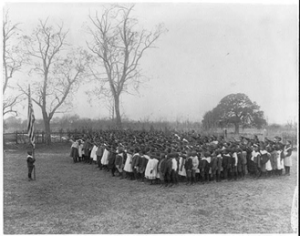
At nine o’clock in the morning on May 1, the procession to this special cemetery began as three thousand black schoolchildren (newly enrolled in freedmen’s schools) marched around the Race Course, each with an armload of roses and singing “John Brown’s Body.” The children were followed by three hundred black women representing the Patriotic Association, a group organized to distribute clothing and other goods among the freedpeople. The women carried baskets of flowers, wreaths, and crosses to the burial ground. The Mutual Aid Society, a benevolent association of black men, next marched in cadence around the track and into the cemetery, followed by large crowds of white and black citizens.
All dropped their spring blossoms on the graves in a scene recorded by a newspaper correspondent: “When all had left, the holy mounds—the tops, the sides, and the spaces between them—were one mass of flowers, not a speck of earth could be seen; and as the breeze wafted the sweet perfumes from them, outside and beyond … There were few eyes among those who knew the meaning of the ceremony that were not dim with tears of joy.” While the adults marched around the graves, the children were gathered in a nearby grove, where they sang “America,” “We’ll Rally Around the Flag,” and “The Star-Spangled Banner.”[3]
In 1866, women in Columbus, Georgia, decided to decorate the graves of the Union as well as the Confederate dead, “as each grave contained someone’s father, brother or son.”[4] Francis Miles Finch, a lawyer in Ithaca, New York, read about the women’s reconciliatory gesture and in 1867 published a poem in the Atlantic Monthly about the ceremony in Columbus, called “The Blue and the Gray” (reprinted below).
In 1868, Maj. Gen. John A. Logan, the head of a Union veterans’ group, the Grand Army of the Republic, called on Americans annually on May 30th to commemorate the deaths of Union and Confederate soldiers by placing flowers on their graves. This annual memorial was initially called “Decoration Day.”[5]
Some contemporaneous accounts claimed that Major Logan’s action was in reaction to the earlier Southern precedent. “The ladies of the South instituted this memorial day,” read The New York Times on June 5th, 1868.[6] “They wished to annoy the Yankees; and now the Grand Army of the Republic in retaliation and from no worthier motive, have determined to annoy them by adopting their plan of commemoration.”
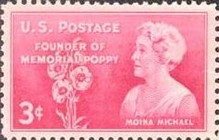
Since World War I, the holiday has changed to honoring Americans who died fighting in any war.[7] In 1971, Congress moved the date of observance from May 30th to the last Monday in May to assure a three-day weekend.[8] In 1915, a Georgia school teacher named Moina Michael, inspired by John McCrae’s poem “In Flanders Field,” began making, selling, and wearing artificial red poppies to benefit veteran-related causes.[9] This poppy tradition continues to be alive and well in several English commonwealth countries.[10] In 2000, Congress passed a “Nation Moment of Remembrance” resolution calling on “Americans everywhere, to pause for one minute at 3:00 p.m. (local time) on Memorial Day, to remember and reflect on the sacrifices made by so many to provide freedom for all.”[11]
To observe Memorial Day, in addition to the readings and songs provided below, you might consider continuing the tradition of visiting a cemetery and decorating a veteran’s grave. Or you might make or purchase a red paper poppy to wear. Or you might pause at 3 p.m. to observe the Moment of Remembrance. Or, if you regularly exercise, you might try to complete the “Murph” CrossFit Workout.
Endnotes
-
↑ 1
U.S. Dept. Veterans Affs., Celebrating America’s Freedoms: The Origins of Memorial Day (n.d.), https://www.va.gov/opa/publications/celebrate/memday.pdf.
-
↑ 2
David W. Blight, Forgetting Why We Remember, N.Y. Times, May 29, 2011, at A19.
-
↑ 3
David W. Blight, Race and Reunion: The Civil War in American Memory (2002).
-
↑ 4
Deborah Fallows, A Real Story of Memorial Day, Atlantic, May 23, 2014, https://www.theatlantic.com/national/archive/2014/05/a-real-story-of-memorial-day/371497
-
↑ 5
Today in History – May 30: Memorial Day, Libr. Cong., https://www.loc.gov/item/today-in-history/may-30/#memorial-day (last visited Jan. 27, 2022).
-
↑ 6
Campbell Robertson, Birthplace of Memorial Day? That Depends Where You’re From, N.Y. Times, May 27, 2012, at A16.
-
↑ 7
The History of Memorial Day, PBS, https://www.pbs.org/national-memorial-day-concert/memorial-day/history/ (last visited Jan. 27, 2022) (“After World War I, it became an occasion for honoring those who died in all of America’s wars and was then more widely established as a national holiday throughout the United States.”).
-
↑ 8
Today in History – May 30: Memorial Day, supra note 6.
-
↑ 9
Sara Freeland, The Poppy Lady: Moina Michael Started a Movement for Veterans, UGA Today, Nov. 5, 2017, https://news.uga.edu/poppy-lady-moina-michael/ (last visited Jan. 27, 2022).
-
↑ 10
Rema Rahman, Who, What, Why: Which Countries Wear Poppies?, BBC, Nov. 9, 2011, https://www.bbc.com/news/magazine-15637074 (last visited Jan. 27, 2022).
-
↑ 11
Statement on the Memorial Day National Moment of Remembrance, [2000] Pub. Papers 818 (May 2).
Guide for Celebration
Every meaningful gathering benefits from gentle guidance—someone to call the group together, set the tone, and help navigate the journey from ordinary time into a space of reflection and back again. This role of celebration Leader is not about authority or expertise, but about service: creating a container within which your family and friends can encounter these powerful texts and ideas together. Think of yourself less as a teacher and more as a facilitator, helping to orchestrate an experience that allows everyone present to engage with America’s founding documents and ongoing story.
The concept of liturgical leadership has deep roots across human cultures. From the ancient symposium to the Passover seder, from Quaker meetings to town halls, communities have long recognized that structured gatherings with designated facilitators help create “liminal space”—a threshold moment set apart from everyday life where transformation and deeper understanding become possible. By taking on this role, you’re not imposing artificial formality but rather tapping into a fundamental human practice: marking significant moments through deliberate, communal action.
If this feels awkward or pretentious at first, you’re not alone. Many Americans are unaccustomed to bringing ceremonial structure to secular holidays beyond saying grace at Thanksgiving. You might worry about seeming preachy or overly formal, especially with teenagers rolling their eyes or relatives who “just want to eat already.”
But consider this: we readily accept structure in other contexts—wedding toasts, birthday songs, even the seventh-inning stretch. What we’re proposing here is simply extending that same intentionality to holidays that celebrate our shared civic life. Start small if needed—perhaps just reading a single paragraph of the Declaration before your Fourth of July barbecue—and build from there. The simple act of pausing together, even briefly, to acknowledge why we’ve gathered can transform a meal into a memory and a holiday into a tradition.
The Leader will gather the people together, saying:
Dear Friends, [Please stand.] We are gathered here to celebrate Memorial Day by reading
[Lincoln’s Gettysburg Address]
[or the poem, In Flanders Fields]
[or by singing Two Brothers]
Please turn to [page xxx of your reader/on the printout on the table/by Googling xxx]. Let us go clockwise around [the table, the circle] starting with [xxx/the youngest/the guest] taking turns each person reading one sentence.
After the reading, the Leader may ask the group one or more of the following questions:
The Leader may conclude the celebration by saying:
Thank you for joining together to celebrate Memorial Day. Let’s continue to reflect on the words we’ve heard, take them into our hearts and minds, and use them to become better friends, better coworkers and students, and better citizens and members of our nation.
Discussion Questions
Discussion Questions for Memorial Day:
- Have you visited the Vietnam Memorial or another memorial that lists the names of people who have died? What do you remember about the visit?
- Why is it important to remember people who died fighting for our country?
- How can we honor all those who die in service when we may have different views about particular conflicts?
- Do you know someone who died in war?
- Are there causes you would be willing to fight and potentially die for?
- How would you feel if there was another draft?
- Reflect on the differences between remembrance and memorialization. How should we understand the respective meanings of these terms in, for instance, how people choose to remember those who fought on different sides during the Civil War?
Readings
Gettysburg Address
On November 19th, 1863, less than five months after the Union and Confederate armies suffered more than 40,000 casualties at the Battle of Gettysburg, President Lincoln traveled to Pennsylvania to the site of the battle to give a concluding dedication. After the famed orator, Edward Everett, spoke for 2 hours, our sixteenth president rose and delivered this ten-sentence speech. This brief text, which can be legibly read on a single iPhone screen, is our nation’s most honored memorial expression.
Gettysburg Address
Abraham Lincoln, 1863[1]
Four score and seven years ago our fathers brought forth on this continent, a new nation, conceived in Liberty, and dedicated to the proposition that all men are created equal.
Now we are engaged in a great civil war, testing whether that nation, or any nation so conceived and so dedicated, can long endure. We are met on a great battle-field of that war. We have come to dedicate a portion of that field, as a final resting place for those who here gave their lives that that nation might live. It is altogether fitting and proper that we should do this.
But, in a larger sense, we can not dedicate—we can not consecrate—we can not hallow—this ground. The brave men, living and dead, who struggled here, have consecrated it, far above our poor power to add or detract. The world will little note, nor long remember what we say here, but it can never forget what they did here. It is for us the living, rather, to be dedicated here to the unfinished work which they who fought here have thus far so nobly advanced. It is rather for us to be here dedicated to the great task remaining before us—that from these honored dead we take increased devotion to that cause for which they gave the last full measure of devotion—that we here highly resolve that these dead shall not have died in vain—that this nation, under God, shall have a new birth of freedom—and that government of the people, by the people, for the people, shall not perish from the earth.
Endnotes
-
↑ 1
The text above is from the so-called “Bliss Copy,” one of several versions which Lincoln wrote. Collected Works of Abraham Lincoln (Roy P. Basler, e.d., 1953).
Poems and Songs
In Flanders Fields
John McCrae, 1915.
Between the crosses, row on row
That mark our place; and in the sky
The larks, still bravely singing, fly
Scarce heard amid the guns below.
We are the Dead. Short days ago
We lived, felt dawn, saw sunset glow,
Loved and were loved, and now we lie
In Flanders fields.
To you from failing hands we throw
The torch; be yours to hold it high.
If ye break faith with us who die
We shall not sleep, though poppies grow
In Flanders fields.
The Blue and The Gray
Francis Miles Finch (1827-1907)
Whence the fleets of iron have fled,
Where the blades of the grave-grass quiver,
Asleep are the ranks of the dead:
Under the sod and the dew,
Waiting the judgment-day;
Under the one, the Blue,
Under the other, the Gray
Those in the gloom of defeat,
All with the battle-blood gory,
In the dusk of eternity meet:
Under the sod and the dew,
Waiting the judgement-day
Under the laurel, the Blue,
Under the willow, the Gray.
The desolate mourners go,
Lovingly laden with flowers
Alike for the friend and the foe;
Under the sod and the dew,
Waiting the judgement-day;
Under the roses, the Blue,
Under the lilies, the Gray.
The morning sun-rays fall,
With a touch impartially tender,
On the blossoms blooming for all:
Under the sod and the dew,
Waiting the judgment-day;
Broidered with gold, the Blue,
Mellowed with gold, the Gray.
On forest and field of grain,
With an equal murmur falleth
The cooling drip of the rain:
Under the sod and the dew,
Waiting the judgment -day,
Wet with the rain, the Blue
Wet with the rain, the Gray.
The generous deed was done,
In the storm of the years that are fading
No braver battle was won:
Under the sod and the dew,
Waiting the judgment-day;
Under the blossoms, the Blue,
Under the garlands, the Gray
Or the winding rivers be red;
They banish our anger forever
When they laurel the graves of our dead!
Under the sod and the dew,
Waiting the judgment-day,
Love and tears for the Blue,
Tears and love for the Gray.
Two Brothers
Irving Gordon (1951)
Chords
Am G Am G / Am G Am Gam /
AmG AmD CD AmB7 / C Bm CD Em
Two brothers on their way
Two brothers on their way,
One wore blue and one wore gray
One wore blue and one wore gray,
As they marched along their way
Fife and drum began to play,
All on a beautiful morning
One was gentle, one was kind,
One was gentle, one was kind,
One came back, one stayed behind
Cannonball don’t pay no mind
If you’re gentle or if you’re kind
It don’t think of the folks behind
Or of a beautiful morning
Two girls waiting by the railroad track,
Two girls waiting by the railroad track,
One wore blue and one wore black
One wore blue and one wore black
Waiting by the railroad track
For their lovers to come back
All on a beautiful morning
Travelin’ Solider
Bruce Robison (1996)
Chords
A A / A A / D D / A A / (2x) / G D A A /
He was waiting for the bus in his army green
Sat down in a booth in a cafe there
Gave his order to a girl with a bow in her hair
He's a little shy so she gives him a smile
And talking to me, I'm feeling a little low
She said I'm off in an hour and I know where we can go
He said I bet you got a boyfriend but I don't care
I got no one to send a letter to
Would you mind if I sent one back here to you
Chords
Chorus: / F#m F#m / D D / A A / E E7 / (2x) / E E7 A A /
Never gonna hold the hand of another guy
Too young for him they told her
Waitin' for the love of a travelin' soldier
Our love will never end
Waitin' for the soldier to come back again
Never more to be alone when the letter said
A soldier's coming home
In California then Vietnam
And he told her of his heart
It might be love and all of the things he was so scared of
He said when it's getting kinda rough over here
I think of that day sittin' down at the pier
And I close my eyes and see your pretty smile
Don't worry but I won't be able to write for awhile
The Lord's Prayer said and the Anthem sang
A man said folks would you bow your heads
For a list of local Vietnam dead
Crying all alone under the stands
Was a piccolo player in the marching band
And one name read but nobody really cared
But a pretty little girl with a bow in her hair
And the Band Played Waltzing my Matilda
Eric Bogle (1971)
The economist, Gunnar Knapp, introduced me to this song late one night with the warning, “This song is a bit intense, but the Lord never loved a coward.” Years later my family and I were lucky to go to a moving Anzac Day remembrance of some of the events described in the song, which made me think again about its last verse.
Chords
/GCDG/GDCG/GCDG/GDCG/DDCG/DDCG/GCGEm/GDCG/
/GCGG/GCDD/CCGCC/GDCG/
And I lived the free life of a rover
From the Murrays green basin to the dusty outback
I waltzed my Matilda all over
Then in nineteen fifteen my country said Son
It's time to stop rambling 'cause there's work to be done
So they gave me a tin hat and they gave me a gun
And they sent me away to the war
Chorus: And the band played Waltzing Matilda
As we sailed away from the quay
And amidst all the tears and the shouts and the cheers
We sailed off for Gallipoli
When the blood stained the sand and the water
And how in that hell that they called Suvla Bay
We were butchered like lambs at the slaughter
Johnny Turk he was ready, he primed himself well
He shot us with bullets, he rained us with shells
And in five minutes flat he'd blown us all to hell
Nearly blew us right back to Australia
Chorus: And the band played Waltzing Matilda
As we stopped to bury our slain
We buried ours and the Turks buried theirs
And it started all over again
In that mad world of death, blood and fire
And for seven long weeks I kept myself alive
While the corpses around me piled higher
Then a big Turkish shell knocked me arse over tit
And when I woke up in my hospital bed
And saw what it had done, Christ I wished I was dead
Never knew there were worse things than dying
Chorus: For no more I'll go waltzing Matilda
To the green bushes so far and near
For to hang tent and pegs, a man needs two legs
No more waltzing Matilda for me
And they shipped us back home to Australia
The legless, the armless, the blind, the insane
Those proud wounded heroes of Suvla
And as our ship pulled into Circular Quay
I looked at the place where my legs used to be
And thank Christ there was nobody waiting for me
To grieve and to mourn and to pity
Chorus: And the band played Waltzing Matilda
As they carried us down the gangway
But nobody cheered, they just stood and stared
Then turned all their faces away
And I watch the parade pass before me
I see my old comrades, how proudly they march
Reliving the dreams of past glory
I see the old men, all twisted and torn
The forgotten heroes of a forgotten war
And the young people ask me, "What are they marching for?"
And I ask myself the same question
Chorus: And the band plays Waltzing Matilda
And the old men still answer the call
But year after year their numbers get fewer
Some day no one will march there at all
/GGCC/GAmCD/GGDD/CCCC/GCDG/
Waltzing Matilda, Waltzing Matilda
Who'll go a waltzing Matilda with me
And their ghosts may be heard
As they march beside the billabong
Who'll come a waltzing Matilda with me
Where Have All the Flowers Gone
Words and Music Pete Seeger (1955) with additional words by Joe Hickerson (1960)
This song was inspired by three lines of a Cossack folk song Seeger read in Mikhail Sholokhov’s “And Quiet Flows the Don.” Joe Hickerson added the final two verses to cycle the lyrics back to the beginning.
Chords
/ C Am F G / (3x) / F C F G C C /
Where have all the flowers gone? Long time ago,
Where have all the flowers gone? Girls have picked them, every one,
When will they ever learn? When will they ever learn?
When will they ever learn? When will they ever learn?
Recipes
Coauthor’s Eggplant Parmigiana
Eggplant Parm is the ultimate comfort food. My co-author (in many senses of the term) brought this version to our marriage. It comes out a little differently each time you make it. This recipe serves 6 and takes about an hour to prep and an hour to cook. It can be served warm or chilled.
Eggplant Parm is the ultimate comfort food. My co-author (in many senses of the term) brought this version to our marriage. It comes out a little differently each time you make it. This recipe serves 6 and takes about an hour to prep and an hour to cook. It can be served warm or chilled.
Ingredients
- 2 large eggplants—around 1.5 lbs
- 2 large jars of your favorite marinara or tomato/basil sauce (we like Roa’s Basil Tomato sauce because it has 0 added sugar and provides just enough herbal seasoning for this dish)
- 16 oz shredded mozzarella cheese
- ¾ cup finely grated parmesan cheese
- olive oil, as needed for frying
- 8 oz Italian Style breadcrumbs, about ½ cup at a time, spread in a shallow bowl
- 2-3 eggs, depending on the size, beaten and available in a second shallow bowl
- ½ cup French fried breaded onions (available in the salad section of most grocery stores, or buy French’s in the canned vegetable section)
- Preheat oven to 350 degrees F.
- Thinly slice the eggplant (about ¼-1/3 inch thick). Sprinkle them lightly with salt, layer them with towels or paper towels, and set them aside for 1 hour. This drains off any excess water and helps with frying.
- Brush any excess salt off the eggplant slices.
- Cover the bottom of a large frying pan with about 1/8 to ¼ inch olive oil. Heat on medium until the oil begins to shimmer.
- Dip each slice of eggplant in the beaten egg, and then dredge them through the breadcrumbs. Immediately fry them in the hot oil, turning once, so the breading is slightly browned and the eggplant inside is tender. You can set the friend eggplant on paper towels to take away some excess oil before loading your pan, or put the fried eggplant directly into the pan as you prefer.
- As you continue to fry the eggplant, you’ll start to collect burned breading granules in the oil. We usually scrape this out and freshen the oil occasionally. If you start to run low on oil, you won’t get the kind of browning of your breadcrumbs that make this dish so delicious.
- Use a 13x 9 inch baking dish for this recipe. The method for loading the pan is as follows: line the bottom of the pan with some tomato sauce, then arrange a layer of fried eggplant. Spread a dollop of sauce on each piece of eggplant and then put a small handful of the shredded cheese on top of the sauce. You can sprinkle a bit of parmesan on top of each lawyer as well. Repeat the eggplant-sauce-cheese layering until the pan is full or you’ve used all your eggplant.
- On the very top layer, add some extra tomato sauce and fill in the gaps between eggplant. It’s almost impossible to have too much sauce on this dish, but if you scrimp on the sauce, it won’t bake as nicely, so err on the side of including more sauce. To top off the dish, spread the fried onions lightly.
- Cover loosely with foil (we sometimes fold a piece of foil in half and “tent” it to make sure it stays away from the top layer of cheese). Bake for 20 minutes, remove the foil, and bake for another 20 minutes until golden and bubbling on top. Let it rest for 5 minutes before serving.
Linda’s Great Grandmother’s Cinnamon Rolls
Linda Meyer is an extraordinary law professor who when she is not helping me find readings on Constitutional interpretation (which you can find in the materials for Constitution Day) writes children’s books and musicals about Connecticut’s state constitutional convention. Her family’s cookbook claims that “the immortal Immanuel Kant said, the only thing in this world or the next that is absolutely good in itself, is a baked good.” Here is a simple recipe for cinnamon rolls that is irrefutable proof.
- 1 c. boiling water
- ¾ c. sugar
- 1 c. shortening (lard, Crisco, butter, or a combo)
- 2 eggs, beaten
- 2 pkg yeast in 1 c. lukewarm water
- 1 T. salt
- About 6 c. flour (yes, I know. But Great-Grandma said “about,” so I repeat it here)
For the filling:
- 2/3 cup dark brown sugar (light brown sugar also works)
- 1 ½ tablespoons ground cinnamon
- ¼ cup butter, softened
For the cream cheese frosting:
- oz cream cheese, softened
- 3 tablespoons butter, softened
- ¾ cup powdered sugar
- ½ teaspoon vanilla extract
In a small bowl or cup, put yeast in lukewarm water and dissolve. Set aside for a bit. Put shortening, sugar, and salt in a big bowl, pour boiling water over them, stir, and cool to lukewarm. Add beaten eggs and then that yeast in its water that you set aside (“a bit” is now over). Add flour. Put in frig at least 2 hours.
In a small bowl, mix together brown sugar and cinnamon. Use your hands to sprinkle mixture over the buttered dough, then rub the brown sugar mixture into the butter. Preheat oven to 350 degrees. Roll out the dough into a sheet and sprinkle cinnamon/sugar mixture over the dough sheet. Tightly roll up dough. Cut dough roll into 9 1 inch piece and bake in 9×13 pan for 30-45 minutes or until you can stick a knife point into middle and it comes out clean.
To make the frosting: In the bowl of an electric mixer, combine cream cheese, butter, powdered sugar and vanilla extract. Beat until smooth and fluffy. Spread over cinnamon rolls as soon as you take them out of the oven and serve immediately.
Bobby Baldock’s Cheese Grits Casserole
Tenth Circuit Court of Appeals Judge Bobby Baldock cooked this casserole for me and later gave me this recipe in 1987, when I had traveled to New Mexico as a clerk for Judge James Logan when they were “riding Circuit” to hear cases. I’ve made this recipe innumerable times since then—sometimes without chicken, sometimes with an added dash of Gates BBQ Extra Hot Sauce.
- 2 lbs (boneless chicken breast)
- 2 ¼ cups (whole milk)
- 2 ¼ cups (water)
- 1 tsp (salt)
- 1 cup (quick cooking grits)
- 8 ounces (Velveeta cheese, cubed)
- ½ lb (sharp cheddar cheese, cubed)
- ¼ cup (butter)
- 1 small can (sliced jalapenos, drained)
- 1/8 tsp (garlic powder)
- 2 (eggs, beaten)
Preheat oven to 350 degrees F (175 degrees C). Butter a 9×12-inch baking dish.
Bring milk, water, and salt to a boil in a large saucepan; gradually sprinkle grits into the boiling liquid, stirring to combine. Cook until thickened, about 5 minutes. Bring a separate pan of water to boil and boil chicken breast for 8-10 minutes. Drain water and cubed cooked chicken breast.
Stir processed cheese, sharp Cheddar cheese, chicken butter, garlic powder, jalapenos into grits, stirring until cheese has melted. Let the mixture stand until cooled, about 15 minutes. Stir beaten eggs into grits; transfer to prepared baking dish. Bake in the preheated oven until the top is lightly golden brown and the grits are set, about 45 minutes.
Trivia Challenge
Further Resources
CrossFit Memorial Day Workout “Murph”
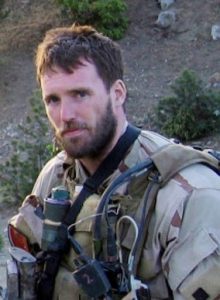 “Murph”
In recent years, the largest Memorial Day observation probably involves physical exhaustion. Hundreds of thousands of Americans at different CrossFit gyms around the country commemorate Memorial Day by attempting to complete the “Murph,” an exhausting exercise routine that was a favorite of Lieutenant Michael Murphy, Navy SEAL and Medal of Honor recipient, who was killed in Afghanistan June 28, 2005. The workout, which Lt. Murphy named “Body Armor” because it is typically completed while wearing a 20-pound vest, consists of the following:
For time: 1 mile Run, 100 Pull-ups, 200 Push-ups, 300 Squats, 1 mile Run
Partition the pull-ups, push-ups, and squats as needed. Start and finish with a mile run. Warning: This is a difficult workout. You should only attempt it if you have been exercising regularly (and regularly perform similar movements). It takes me more than an hour to complete an even radically scaled-down version of the workout. As an alternative way to mark the holiday, you might consider walking for 30 minutes carrying some object that makes you more conscious of the holiday. If you are interested in starting to exercise more regularly, you can learn more at CrossFit.com.[1]
Lt. Murphy’s Medal of Honor citation includes the following details of his heroism (also depicted in the 2013 film Lone Survivor):
While leading a mission to locate a high-level anti-coalition militia leader, Lieutenant Murphy demonstrated extraordinary heroism in the face of grave danger in the vicinity of Asadabad, Kunar Province, Afghanistan. On 28 June 2005, operating in an extremely rugged enemy-controlled area, Lieutenant Murphy’s team was discovered by anti-coalition militia sympathizers, who revealed their position to Taliban fighters. As a result, between 30 and 40 enemy fighters besieged his four-member team. Demonstrating exceptional resolve, Lieutenant Murphy valiantly led his men in engaging the large enemy force. The ensuing fierce firefight resulted in numerous enemy casualties, as well as the wounding of all four members of the team. Ignoring his own wounds and demonstrating exceptional composure, Lieutenant Murphy continued to lead and encourage his men. When the primary communicator fell mortally wounded, Lieutenant Murphy repeatedly attempted to call for assistance for his beleaguered teammates. Realizing the impossibility of communicating in the extreme terrain, and in the face of almost certain death, he fought his way into open terrain to gain a better position to transmit a call. This deliberate, heroic act deprived him of cover, exposing him to direct enemy fire. Finally achieving contact with his headquarters, Lieutenant Murphy maintained his exposed position while he provided his location and requested immediate support for his team. In his final act of bravery, he continued to engage the enemy until he was mortally wounded, gallantly giving his life for his country and for the cause of freedom.[2]
Two powerful speeches by Oliver Wendell Holmes convey the importance of celebrating Memorial Day. See “In Our Youth Our Hearts Were Touched With Fire,” delivered on Memorial Day, May 30, 1884, at Keene, NH, before John Sedgwick Post No. 4, Grand Army of the Republic. See also “The Soldier’s Faith,” delivered on Memorial Day, May 30th, 1895, at a Meeting Called by the Graduating Class of Harvard University. President Theodore Roosevelt’s admiration for the latter speech was one of the factors that led to Justice Holmes’s later nomination for the Supreme Court. See Richard Posner, The Essential Holmes: Selections From the Letters, Speeches, Judicial Opinions, and Other Writings of Oliver Wendell Holmes, Jr. (1992).
For fictional narratives detailing the experiences of war, see Erich Maria Remarque, All Quiet on the Western Front (1929), which provides an account of World War I; Tim O’Brien, The Things They Carried (1990), which depicts the Vietnam War; and Stephen Crane, The Red Badge of Courage (1895), which accounts the Civil War.
For more poems to be read on Memorial Day, see Mary Frye, Do Not Stand At My Grave And Weep (1932); Wilfred Owen, Dulce Et Decorum Est (1918); Wilfred Owen, Anthem for Doomed Youth (1917); T.S. Eliot, The Wasteland (1922); Robert Frost, Not to Keep (1917); Herman Melville, Shiloh: A Requiem (1866); Stephen Crane, War is Kind (1899); Walt Whitman, Dirge for Two Veterans (1867); Carl Sandburg, Grass (1918); Lord Alfred Tennyson, The Charge of the Light Brigade (1854); Thomas Hardy, Channel Firing (1914); Unknown Author, The Blue and The Gray; Major Van E. Harl, We Buried Another Veteran Today (2001); Eula Gladys Lincoln, Memorial Day; Kelly Strong, Freedom Isn’t Free; and Kelly Strong, The Wall.
For songs to commemorate our war heroes, see John McCutcheon, Christmas in the Trenches (1984); Barry Sadler & Robin Moore, Ballad of the Green Beret (1966); Francis Scott Key, When the Warrior Returns; Patrick Gilmore, When Johnny Comes Marching Home (1863); and John La Touche, Ballad for Americans (1939).
Endnotes
-
↑ 1
Michael Easter, How Murph Became the Most Legendary Fitness Challenge Ever, Men’s Health, May 6, 2021, https://www.menshealth.com/fitness/a36163839/murph-workout-crossfit-challenge/ (last visited Jan. 27, 2022).
-
↑ 2
Official Citation: Lieutenant Michael P. Murphy, United States Navy, U.S. Navy, https://www.navy.mil/MEDAL-OF-HONOR-RECIPIENT-MICHAEL-P-MURPHY (last visited Jan. 27, 2022).
Community Uploads
Share Your Memorial Day Traditions
A community space for celebrating how Americans honor this day
Every family and community celebrates Memorial Day in their own unique way. We invite you to share your traditions, photos, videos, recipes, and reflections with fellow Americans. Your contribution helps build a richer understanding of how we come together as a nation to mark this important day.
What We’re Looking For
We welcome submissions that capture the spirit of Memorial Day celebrations across America. Here are some ideas:

Family Traditions

Photos

Videos

Recipes

Readings & Reflections

Regional Celebrations
Submit Your Contribution
Please complete the form below to share your Memorial Day tradition with our community.
"*" indicates required fields
Review
We will review your submission to ensure it aligns with our community guidelines.
Notification
You'll receive an email letting you know whether your submission has been approved for publication.
Publication
Approved submissions will appear in the Community Uploads gallery on this holiday's page.
Attribution
Your name and location (city, state) will be displayed with your submission unless you request otherwise.
Community Guidelines
- Is appropriate for all ages and family audiences
- Respects the diverse ways Americans may celebrate this holiday
- Does not contain copyrighted material you don’t have permission to share
- Does not include political campaigning or commercial advertising
- Treats all individuals and communities with dignity and respect
Browse Community Traditions
Explore how fellow Americans celebrate Memorial Day.
Your Traditions Matter
America is a nation of many traditions—each family, community, and region bringing something unique to our shared holidays. By sharing your celebration, you help preserve these traditions and inspire others to bring more meaning to their own Memorial Day gatherings.